

Zero To Hero Binary Options Pdf

Call back about this: you are traveling from Chandler, AZ, to San Diego, CA. Your hope is to get at that place in as little time as possible, hence aiming to minimize travel time. At the same time, you will be facing more or less traffic on certain stretches of the trip, you lot volition need to cease for gas at least one time (unless you are driving a hybrid vehicle), and, if you take kids, you'll definitely need to terminate for a restroom break. While we have only mentioned a few, these are all
constraints—things that limit you in your goal to become to your destination in as little time equally possible.
Solving Linear Programming Problems Graphically
A linear programming problem involves constraints that contain inequalities. An
inequality is denoted with familiar symbols, <, >,
, and
. Due to difficulties with strict inequalities (< and >), nosotros volition only focus on
and
.
In lodge to have a linear programming problem, we must have:
- Inequality constraints
- An objective function, that is, a function whose value we either want to be equally large as possible (want to maximize information technology) or equally small as possible (want to minimize it).
Case 1

Solution
The outset stride is to identify the unknown quantities. Nosotros are asked to find the number of each ticket that should be sold. Since at that place are double-decker and starting time-course tickets, we identify those as the unknowns. Let,
x = # of coach tickets
y = # of showtime-class tickets
Next, we demand to identify the objective function. The question ofttimes helps us identify the objective function. Since the goal is the maximize profits, our objective is identified.
Profit for coach tickets is $225. If
x coach tickets are sold, the total turn a profit for these tickets is 225x.
Profit for offset-class tickets is $200. Similarly, if
y first class tickets are sold, the total profit for these tickets is 200y.
The total turn a profit,P, is
P = 225x + 200y
Nosotros desire to brand the value of
as large equally possible, provided the constraints are met. In this case, nosotros accept the following constraints:
- Sell at least 25 beginning-class tickets
- Sell at least 40 double-decker tickets
- No more than than 150 tickets can exist sold (no more 150 people can fit on the plane)
Nosotros need to quantify these.
- At to the lowest degree 25 starting time-class tickets means that 25 or more should be sold. That is, y
25 - At least xl autobus tickets means that 40 or more should be sold. That is, x
forty - The sum of first-course and motorbus tickets should be 150 or fewer. That is x + y
150
Thus, the objective function along with the three mathematical constraints is:
Objective Role: P = 225ten + 200y
Constraints: y
25; x
40; 10 + y
150
Nosotros volition work to think about these constraints graphically and return to the objective function subsequently. Nosotros will thus deal with the following graph:

Nosotros volition first plot each of the inequalities as equations, and then worry near the inequality signs. That is, showtime plot,
x= 25
y = forty
x + y = 150
The first 2 equations are horizontal and vertical lines, respectively. To plot x + y= 150, information technology is preferable to find the horizontal and vertical intercepts.
To find the vertical intercept, we let
x = 0:
y= 150
Giving united states the point (0,150)
To find the horizontal intercept, we let
y = 0:
ten = 150
Giving us the betoken (150,0)
Plotting all three equations gives:

We first inquire, when isy
25? Since this is a horizontal line running through a y-value of 25, annihilation in a higher place this line represents a value greater than 25. We announce this by shading above the line:

y
25.
Next, we deal with
x
twoscore. We ask, when is the ten-value larger than 40? Values to the left are smaller than xl, then we must shade to the right to get values larger than 40:

all constraints, simply the region that is green and blueish will suffice.
We have i more constraint to consider:
ten+ y
150. We take two options, either shade below or shade above. To help united states better run across that we volition, in fact, need to shade below the line, let u.s. consider an ordered pair in both regions. Selecting an ordered pair above the line, such as (64, 130) gives:
64 + 130
150
Which is a faux statement since 64 + 130 = 194, a value larger than 150.
According to the graph, the betoken (64, 65) is one that falls below the graph. Putting this pair in yields the statement:
64 + 65
150
Which is a true statement since 64+65 is 129, a value smaller than 150.


64
40 True
65
25 Truthful
64 + 65
150 TRUE
This gets the states to a great point, only still does not answer the question:
which betoken maximizes turn a profit? Fortunately, there is a theorem discovered by mathematicians that allows us to answer this question.
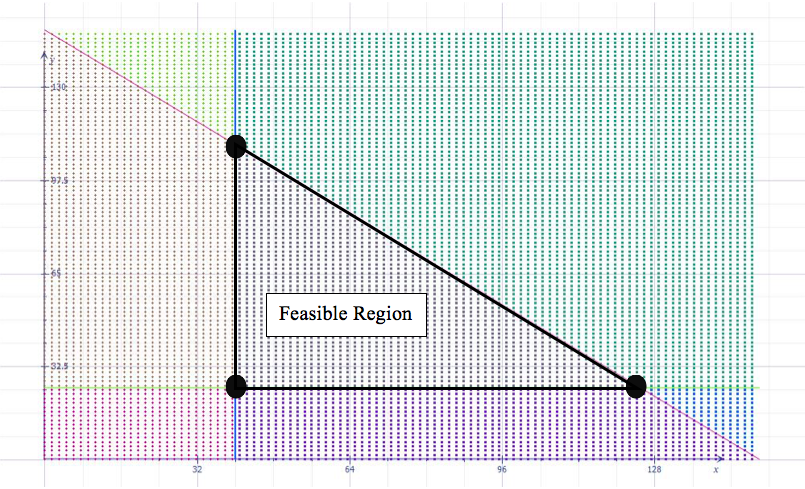
First off, we ascertain a new term: acorner indicate is a point that falls along the corner of a viable region. In our situation, nosotros have 3 corner points, shown on the graph every bit the solid black dots:
Key Theorem of Linear Programming
- If a solution exists to a divisional linear programming problem, then information technology occurs at ane of the corner points.
- If a feasible region is unbounded, then a maximum value for the objective role does not be.
- If a feasible region is unbounded, and the objective office has only positive coefficients, so a minimum value exist
This means nosotros have to cull among iii corner points. To verify the "winner," we must meet which of these 3 points maximizes the objective role. To observe the corner points every bit ordered pairs, we must solve three systems of two equations each:
Organization one
ten= forty
x + y = 150
Organisation 2
x= xl
y= 25
Organisation 3
y = 25
ten+ y = 150
We could decide to solve by using matrix equations, but these equations are all elementary enough to solve past hand:
System 1
(40) + y = 150
y = 110
Bespeak:(forty,110)
System 2
Point already given
Point: (40,25)
System 3
x + 25 = 150
10 = 125
Point: (125,25)
We test each of these iii points in the objective role:
| Bespeak | Turn a profit |
| (40,110) | 225(40) + 200(110) = $31,000 |
| (40,25) | 225(40) + 200(25) = $14,000 |
| (125,25) | 225(125) + 200(25) = $33,125 |
The 3rd point, (125,25) maximizes profit. Therefore, nosotros conclude that the airline should sell 125 coach tickets and 25 offset-grade tickets in gild to maximize profits.
The above case was rather long and had many steps to consummate. We will summarize the procedure below:
Solving a Linear Programming Trouble Graphically
- Define the variables to exist optimized. The question asked is a good indicator as to what these volition exist.
- Write the objective function in words, then convert to mathematical equation
- Write the constraints in words, then convert to mathematical inequalities
- Graph the constraints as equations
- Shade feasible regions by taking into business relationship the inequality sign and its direction. If,
a)A vertical line
, so shade to the left
, so shade to the right
b) A horizontal line
, then shade below
, then shade in a higher place
c) A line with a not-zip, defined slope
, shade beneath
, shade above
6. Identify the corner points by solving systems of linear equations whose intersection represents a corner bespeak.
7. Exam all corner points in the objective function. The "winning" point is the point that optimizes the objective function (biggest if maximizing, smallest if minimizing)
There is one instance in which we must take great circumspection. First, consider the (true) inequality,
5 > 3
Suppose nosotros were to divide both sides by –1. Would it still be truthful to say the following?
Clearly, –v is not larger than –3! To keep the statement truthful, we should change the management of the inequality sign then that,
–5 < –3
We can see past the number line beneath, that the ii sets of numbers are symmetric about 0, except that the manner in which nosotros draw size is opposite. This justifies that we should also utilize the reverse sign when we reverberate values to the other side of 0.

Irresolute the Inequality Sign
When multiplying/dividing any inequality by –1, the direction of the inequality should change
Example 2
A health-food business would similar to create a high-potassium blend of dried fruit in the class of a box of 10 fruit bars. It decides to use dried apricots, which have 407 mg of potassium per serving, and dried dates, which have 271 mg of potassium per serving (SOURCE: www.thepotassiumrichfoods.com).
The company tin can purchase its fruit through
www.driedfruitbaskets.com in majority for a reasonable price. Dried apricots cost $9.99/lb. (virtually 3 servings) and dried dates cost $vii.99/lb. (almost iv servings). The company would like the box of bars to have at least the recommended daily potassium intake of about 4700 mg, just would like to proceed it under twice the recommended daily intake. In social club to minimize cost, how many servings of each dried fruit should become into the box of bars?
Solution
We begin by defining the variables. Allow,
10 = # of servings of dried apricots
y = # of servings of dried dates
We next piece of work on the objective function.
For apricots, at that place are three servings in one pound. This means that the cost per serving is $ix.99/3 = $3.33. The cost for
x servings would thus be 3.33ten.
For dates, in that location are four servings per pound. This ways that the cost per serving is $7.99/4
$2.00. The cost for y servings would thus exist ii.00y.
The total cost for apricots and dates would exist
C = 3.33x + 2.00y
Nosotros have 2 major constraints (in addition to the constraints that
x
0
and y
0, given that negative servings cannot be used):
- Production must contain at to the lowest degree 4700mg of potassium
- Product should incorporate no more than 4700 × 2 = 9400mg of potassium
Mathematically,
- There are 407x mg of potassium in 10 servings of apricots and 271y mg of potassium in y servings of dates. The sum should be greater than or equal to 4700mg of potassium, or 407x + 271y
4700 - The aforementioned sum should be less than or equal to 9400 mg of potassium, or 407x + 271y
9400.
Thus we accept,
Objective Function : C = three.33x + 2.00y Subject To Constraints:
407x + 271y
4700
407ten + 271y
9400
10
0
y
0
We graph the constraints as equations:

, we must shade above and, since the second inequality has
, nosotros must shade below (This idea tin be confirmed by selecting points above and below each line in club to verify.):


System 1
x = 0
407ten + 271y =4700
Solution:
0 + 271
y = 4700
y ≈ 17.3
Point: (0,17.3)
System 2
x = 0
40710 + 271y = 9400
Solution:
0 + 271y = 9400
y ≈ 34.7
Signal: (0,34.7)
System iii
y = 0
407x + 271y = 4700
Solution:
407x + 0 = 4700
x ≈ 11.five
Betoken: (11.5,0)
System 4
y = 0
40710 + 271y = 9400
Solution:
407x + 0 = 9400
x ≈ 23.one
Point: (23.one,0)
Over again, we could solve by using matrix equations, merely the systems are straightforward to solve by substitution. Since the problem is divisional, we now check to see which one minimizes cost:
| Betoken | Cost |
| (0,17.iii) | 33.3(0) = 2.00(17.3) = $34.sixty |
| (0,34.7) | 33.three(0) = two.00(34.7) = $69.40 |
| (11.v,0) | 33.3(11.v) = 2.00(0) = $38.xxx |
| (23.i,0) | 33.iii(23.ane) = 2.00(0) = $76.92 |
The cheapest route for the company volition be to create bars that incorporate no dried apricots and 17.iii servings of stale dates.
It is interesting to notation that each of the corner points corresponds to either a horizontal or vertical intercept.
Why are we seeing what nosotros're seeing? This is truly a case of existent-world product cosmos! Of course, it doesn't make sense to increase the daily intake for the box, since this would mean increasing the amount of dried fruit, hence increasing cost. Since the cost of dried dates is cheaper ($2.00 per serving) and since for the price of 1 serving of apricots ($3.33 per serving) we tin can pay:
mg per dollar for apricots
and
mg per dollar for dates
Information technology makes consummate sense to buy dates, since the same dollar amount yields a higher content of potassium.
The question still remains: is it desirable to require a larger quantity of dates for a smaller price, or is information technology more than desirable to crave a smaller quantity of apricots for a larger price? This indeed depends on the constraints. The company might want to consider the amount of packaging/processing/etc. required in both instances. Possibly the manufacturing and packaging costs could add together constraints that change the decision-making process. A like trouble will be left as a homework practice for the reader to think nigh.
As a mathematical note, what nosotros are seeing occurs as a issue of having constraint lines that are parallel.
At that place are two terms we should be familiar with when dealing with inequalities:bounded and unbounded. A feasible region is said to be bounded if the constraints enclose the feasible region.
That is, if the shading does not continue to cover the entire airplane, we are dealing with a divisional linear programming problem.
Both examples thus far have been examples of bounded linear programming bug, since the commencement feasible region was in the shape of a triangle and the second in the shape of a trapezoid.
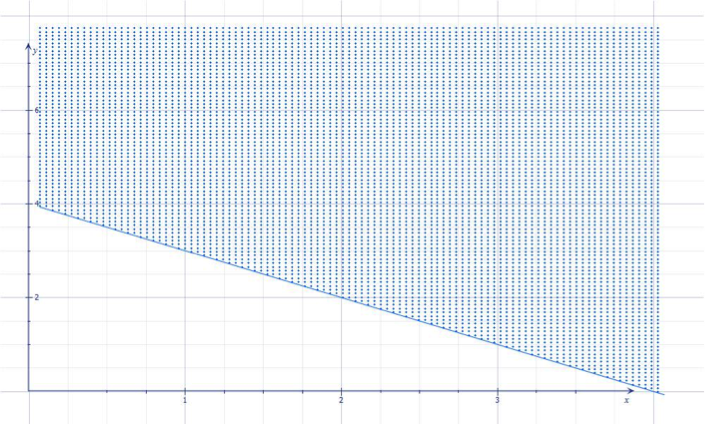
If the feasible region cannot be enclosed among the lines formed by constraints, it is said to be unbounded. An example of an unbounded linear programming problem would be:
Example 3
A human being resource office is working to implement an increase in starting salaries for new authoritative secretaries and faculty at a community college. An administrative secretary starts at $28,000 and new faculty receive $xl,000. The higher would like to determine the pct increment to allocate to each grouping, given that the college will be hiring eight secretaries and 7 faculty in the upcoming academic year. The college has at near $five,000 to put towards raises. What should the percentage increase be for each group?
Solution
Our goal is to determine the percentage increase for authoritative secretaries and faculty, so let
x = pct increase for secretaries
y = percentage increase for faculty
The college would similar to minimize its total expenditures, so the objective function must include the full corporeality of money outflows. Since the new secretaries will require a total upkeep of
$28,000 × 8 = $224,000 and the faculty a full budget of $40,000 × seven = $280,000, the total toll will exist the heighten pct for each grouping, multiplied past the total salaries:
C = 224x + 280y
There is one constraint given, which is that the total raises must be $five,000 or less. That is,
224x + 280y
5
Of course, the college does not want to reduce the salaries, so
10
0 and y
0.
To visualize the situation, we graph the constraint as an equation. To assist u.s.a. observe points, nosotros get-go discover the intercepts:
Horizontal Intercept: 224(0) + 280
y = 5
y ≈ .018
Vertical Intercept 224x + 280(0) = 5
x ≈ .022
We then plot the points and connect them with a straight line:

, nosotros shade beneath the line:

| Betoken | Cost |
| (0,0) | 224(0) + 280(0) = $0 |
| (0,.018) | 224(0) + 280(.018) = $5.04 |
| (.020,0) | 224(.020) + 280(0) = $4.48 |
Conspicuously, the first pick gives the smallest cost; however, this combination of tells us to requite a 0% enhance to both groups, which, of form, is not practical, since the company'southward goal was to requite a heighten to each grouping.
Why did this happen, and what should we practice to prepare information technology? Well, when nosotros think about the constraint of spending $5,000 or less and hoping to brand expenditures every bit small-scale as possible, wouldn't it make sense to say, "don't spend anything!"? This consequence will occur someday we are minimizing, have constraints with the
le inequality sign, and when the origin is included in the viable region. To fix the trouble, the visitor should make additional specifications, such as, what is the minimum percent raise to give to each group? Is it desirable for one of the raises to be larger than the other? These are questions the analyst should hash out with human being resources and assistants.
Practice Problems
i) Solve each of the following linear programming issues.
a) Maximize R = 2x + 3y Subject area to –2x – y 10 + 3y
0
y
Solution: R=30 at (0,10)
B) Minimize T = 310 + y Subject to ten + 2y x + 3y
0
y
Solution: R=2 at (0,2)
2) A local school governing board approves a new math pedagogy program that is to be implemented at a series of elementary schools within the district. Money for the program volition come from two different budgets: public expenditures budget and grade-schoolhouse initiatives budget. The board is willing to pay at least half of what comes out of the initiatives budget from its public expenditures budget. Since this program is considered an initiative, the government mandates that at least $two,000 comes from the local initiatives budget. Both budgets are partially funded by federal emergency funding. For the public expenditures budget, the percentage is 55% and 23% for the form-schoolhouse initiatives upkeep. In order to properly use emergency funding, the district would like to minimize the use of federal dollars. How much should come from each budget?
Solution: x=amount from publix expenditures; y=amount from course school initiatives
Minimize: C=0.55x+0.23y
(1/ii)x≥y or {(1/2)x-y≥0}
y≥2000
ten,y≥0
Solution: C=2660, x=4000, y=2000
3) A public relations director for a homeopathic is seeking to annunciate her visitor'south products on two different websites—one is a medical parts supplier and the other is a fitness e-zine (a spider web-based magazine). The medical parts supplier website receives, on average, about ane,200,000 hits per twenty-four hours per page, while the fitness e-zine receives almost 2,000,000 hits per 24-hour interval per page. The daily cost to advertise is $1,100 per ad and $1,600 per advertisement, respectively. The managing director would similar at to the lowest degree 15 ads and is able to classify up to $50,000 for advertising. At least 3 ads should be placed on each website. How many adds should be placed on each website to maximize the potential number of readers (fifty-fifty if some viewers see the add on different pages of the website)?
x=number on medical website; y= number on fitness website.
Maximize: R=1200000x+2000000y
Bailiwick to:
x+y≥15
1100x+1600y≤50000
x≥3
y≥three
ten,y≥0
| Corner Points | R=1200000x+2000000y |
| (3,12) | 27,600,000 |
| (12,3) | 20,400,000 |
| (three,29.2) | 62,000,000 |
| (41.i,3) | 55,320,000 |
Optimal Solution
See more examples in next section.
Licenses and Attributions
CC licensed content, Shared previously
- By the Numbers, Meeting Demands with Linear Programming. Authored by: Milos Podmanik. License: CC Past: Attribution

Zero To Hero Binary Options Pdf,
Source: https://www.coursehero.com/study-guides/sanjacinto-finitemath1/reading-meeting-demands-with-linear-programming/
Posted by: millerkinty1942.blogspot.com
0 Response to "Zero To Hero Binary Options Pdf"
Post a Comment