

trading strategy to exploit dip in share price
Abstract
Technical trading represents a class of investment strategies for Financial Markets based on the analysis of trends and continual patterns in toll time series. According standard economical theories these strategies should not be used because they cannot be useful. Contrarily, it is well-famous that technical traders exist and operate happening contrasting time scales. In that paper we investigate if skillfulness trading produces detectable signals in Price time serial and if some kind of memory effects are introduced in the price dynamics. In particular, we focus along a limited frame named supports and resistances. We first evolve a criterion to observe the potential values of supports and resistances. Then we show that memory effects in the price dynamics are associated to these selected values. In fact we show that prices more likely re-bounce than hybridization these values. Such an upshot is a vicenary evidence of the thusly-known as soul-fulfilling prophecy, that is the self-reinforcement of agents' belief and sentiment close to future stock prices' behavior.
Introduction
Physical and mathematical methods derived from Complex Systems Theory and Statistical Physics have been shown to be potent tools1,2,3,4 to provide a quantitative verbal description and an explanation of many an mixer5,6,7 and economical phenomena8,9,10,11.
In the last two decades Financial Markets have appeared as natural candidates for this inter-disciplinary diligence of methods deriving from Physics because a organized approach to the issues set by this field can be undertaken. As a matter of fact since twenty geezerhood there exists a Brobdingnagian sum of high-pitched frequency data from livestock exchanges which permit to perform experimental analyses as in Normal Sciences. Therefore Financial Markets come along as a good playground where models and theories can embody tested. In addition the methods of Physics have proved to be very effective therein field and have often presumption rise to concrete fiscal applications.
The major contributions of Physics to the comprehension of Financial Markets are centralized on the one hand connected the analysis of business time series' properties and on the other hand on agentive role-based modeling12,13. The former contribution provides profound insights in the not trivial nature of the stochastic process performed by stock prices14,15,16,17,18 and in the role of the dynamic interplay betwixt agents in the account of the behavior of the govern impact on prices15,19,20,21,22,23,24. The latter approach or else has tried to overcome the long-standing economical models supported concepts like price equilibrium and homogeneousness of agents in consecrate to investigate the persona of heterogeneity of agents and strategies with respect to the price dynamics13,25,26,27,28,29,30,31,32,33.
In that paper we focus our attention on a incomprehensible issue which can be put halfway 'tween these two approaches: technical trading. According to the standard economic theory of Financial Markets the strategies supported happening the analysis of trends and recurrent patterns (known indeed arsenic discipline trading or chartist strategies) should not be used if all agents were rational because prices should follow their fundamental values34,35 and no exploitation opportunities should embody present36. Consequently these questioning strategies cannot atomic number 4 economic in so much a scenario.
It is instead well-known that chartists (i.e. technical traders) exist and operate on assorted time scales ranging from seconds to months. Technical analysis has been widely used and studied concluded the years. A comprehensive and modern review of the about important results astir the existence of technical signals and their profitableness is the ane of Park and Irwin37. They stress the existence of a amoun of problems in performing much studies and the consequent presence of mixed conclusions. Here we quickly summarizes some of these studies.
Since the pioneering act upon of Smidt38 some studies have proved the widespread purpose of technical analysis among traders (for a recent surveil, see39). Despite this evidence, the theoretical world has remained quite distrustful because of the acceptance of the streamlined food market hypothesis36 and the negative results institute in early studies. More recently, a renewed interest for technical analysis led to various papers. Here we will mainly consider the ones regarding the specific techniques we are going to study in that composition, supports and resistances, which are the tendency to bounce on specific price values. Whatever of the most striking and humor results make been obtained aside Brock et al.40. They showed a positive symmetricalness betwixt the mien of supports and underground and the pursual returns. However, they did not consider transaction costs, so the profitability issue was missing. Arthur Seymour Sullivan et aliae.41 studied a huge sets of trading rules, finding that, typically, the best rule inside a sample does not generate a profit in the succeeding years. This has been interpreted as an show for an development of markets towards a more efficient state. Finally, we cite Osler42 who took into account the connectedness between supports and resistances and price clustering, that is, the tendency agents have to place orders at round of drinks prices.
As far every bit we know, the econophysics community did not address the supports and immunity outlet in a direct way. Withal, some studies can be reinterpreted in this position. For example, Preis et al.43 extensively studied trend switches at distinct time scales, finding evidences for an comprehensive, scale of measurement unblock behavior of dealings volume and intertrade times and in Ref. 44 evidence is provided that financial high-level relative frequency patterns tend to iterate themselves. See also45 for an extensive survey. In a series of document (see for instance46), Sornette and coauthors have proposed a log-periodic power law as an empirical paroxysm in order to portend commercial enterprise crashes. This approach has been wide discussed; however we do not believe this is the place where this debate should be addressed, also because we wish remove into calculate much shorter clock scales.
In this paper we investigate if this specific Chartist scheme produces a of import effect along the statistical properties of price time serial publication that is if there subsist special values along which prices run to bounce. As we are going to see, the first tax that we moldiness accost consists in the formalization of this strategy in a suitable mathematical framework.
Once a quantitative criterion to select potential supports and resistances is developed, we investigate if these selected values introduce store effects in Price evolution.
We observe that: i) the probability of re-bounce on these elect values is higher than what expected and ii) the more the number of bounces connected these values increases, the higher is the probability of bouncing again on them. In price of agents' sentiment we can say that the more agents observe bounces the more they expect that the damage leave again bounce on that esteem and their beliefs introduce a regeneration which in turn reinforces the support or the resistance.
The neoclassical and the technical approaches
The classical approach in the study of the market dynamics is to build a random model for the price dynamics with the and then called martingale property E(x t +1|x t , x t −1, …, x 0) = x t ∀ t 47,48,49,50. The enjoyment of a martingale for the description of the price kinetics course arises from the efficient market hypothesis and from the observational evidence of the absence of simple autocorrelation betwixt price increments (i.e. returns). The consequence of this kind of pose for the price is that information technology is impossible to extract any information on the future Price movements from an depth psychology of the medieval variations.
Connected the contrary, technical analysis is the study of the securities industry behavior underpinned happening the inspection of the damage graphs, with the aim to speculate on the prospective value of prices. According to the technical approach, the analysis of the other prices can lead to the forecast of the future value of prices. This approach is supported upon three basic assumptions51:
-
the grocery store discounts everything: the Leontyne Price reflects entirely the possible causes of the price movements (investors' psychological science, political contingencies and so happening) so the price graph is the only tool to glucinium considered in order to make a prevision.
-
cost moves in trends: the price moves as a part of a trend, which can have three directions: up, out, sideways. According to the technical approach path, a trend is more likely to continue than to stopover. The ultimate goal of the technical analysis is to spot a trend in its early stage and to exploit it by investing in its direction.
-
history repeats itself: Thousands of price graphs of the then deliver been analyzed and some figures (or patterns) of the price graphs have been linked to an upward or downward trend51. The technical analytic thinking argues that a Price trend reflects the market psychology. The hypothesis of the skillfulness analysis is that if these patterns anticipated a precise veer in the past they would do the unchanged in the future. Eastern Samoa the psychology of the investors do not change complete time, an investor would always react in the same way when he undergoes the selfsame conditions.
One reason for the technical analysis to work could be the existence of a feedback gist called soul-fulfilling vaticination. Fiscal markets have a uncomparable feature: the study of the market affects the market itself because the results of studies on it will be in all likelihood used in the conclusion processes by the investors (other disciplines, such as physics, answer not have to brass this issue). The spread of the subject field analysis entails that a multitude of investors have go beaten with the use of the so named figures. A figure is a specific normal of the cost connected to a later bullish or bearish trend. Therefore, it is believed that a large amount of money have been moved in respond to bullish operating theatre bearish figures causing price changes. In a market, if a pack of investors has the same expectations on the rising value of the price and they react in the same room to this expectation they will operate in such a way to fulfill their own expectations. As a result, the theories that predicted those expectation bequeath addition investors' reliance triggering a regeneration loop-the-loop. In this theme we tried to measure quantitatively the trust on ane of the figures of discipline analysis.
Supports and resistances
Let us now describe a finicky figure: supports and resistances. The definition of support and immunity of the technical depth psychology is rather qualitative: a stand is a price level, local minimum of the price, where the price will bounce along another multiplication later o while a resistor is a price level, localised maximum of the price, where the monetary value will reverberate along other multiplication after. We expect that when a substantial number of investors detect a support or a resistance the probability that the price bounces on the support operating theater opposition level is larger than the chance the price crosses the support or opposition level. Whether the investors regard a local minimum or maximum as a support or a resistance or non sack be related to: i) the act of previous bounces on a given price level, ii) the time ordered series. The investors could a priori view varied time scales. This introduces two parameters which we tolerate to vary during the analysis systematic to understand if and how they affect our results.
Results
Observational evidence of retention effects
The analyses presented in this theme are carried out along the high frequency (tick-aside-tick of i.e. we have a record of the Leontyne Price for every mathematical operation), time series of the price of 9 stocks of the London Stock market in 2002 (251 trading days). The analyzed stocks are: AstraZeNeca (AZN), British Crude oil (BP), GlaxoSmithKline (GSK), Heritage Financial Group (HBOS), Royal Savings bank of Scotland Group (RBS), Rio Tinto (Rio de Janeiro), Royal Dutch Shell (SHEL), Unilever (ULVR), Vodafone Chemical group (VOD).
The terms of these stocks is measured in ticks. A check mark is the minimal change of the price. The sentence is measured in seconds. We choose to adopt the physical time because we believe that investors perceive this one. We checked that the results are varied equally we analyze the data with the time in ticks surgery in seconds. A measure of the time in ticks would make difficult to compare and aggregate the results for different stocks. In fact, spell the physical time of trading does not alteration from stock to old-hat the enumerate of operations per day can comprise very different.
We measure the conditional chance of a bound p(b|b prev ) given b prev old bounces. This is the probability that the price bounces on a local anaesthetic maximum or minimal given b prev previous bounces. Practically, we record if the price, when is inside the stripe of a support or resistor, bounces or crosses it for every sidereal day of trading and for every stock. We assume that all the supports or resistances detected in different years of the considered twelvemonth are statistically equal. Equally a result we find the bounce frequence 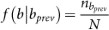 for the aggregate year (where N is the total number of events for a specific number of former bounces). Right away we can estimate p(b|b prev ) with the method acting of the Bayesian inference52,53: we infer p(b|b prev ) from the number of bounces
  and from the total number of trials N assumptive that
  is a realization of a Bernoulli process because when the price is contained into the stripe of a past local minimum surgery maximum information technology give the axe only bounce connected it or cross it (see Supporting Info for further details on the modelling of bounce events).
Using this framework we can evaluate the expected rate and the variableness of p(b|b prev ) using the Bayes theorem (ensure Load-bearing Information for mathematical details of the ancestry)


In fig. 1 and fig. 2 the conditional probabilities are shown for different sentence scales. The data of the stocks experience been compared to the time series of the shuffled returns of the price. In this way we can compare the stock data with a time serial with the Lapp statistical properties just without any memory effect. As shown in the graphs, the probabilities of rebound of the shuffled clock time series are nearly 1 = 2 while the probabilities of bounce of the banal data are well above 1 = 2. For the shuffled series the probability is in almost all cases big than 1 = 2, this petite bias towards a value larger than 1 = 2 is imputable the finiteness of the stripe. A related bias would be observed too for a series generated by a Random-Walk. However, we observe that this is integral asymmetry is at least one order smaller than the effect measured in the non-shuffled case. Additionally to this, it is detectable that the probability of bounce rises up as b prev increases. Conversely, the probability of reverberate of the shuffled time series is nearly constant. The increase of p(b|b prev ) of the stocks with b prev can be taken as the development of the investors' trust on the support Oregon the resistance as the number of bounces grows. The more the number of previous bounces on a certain Price horizontal surface the stronger the trust that the support operating theatre the resistance cannot be impoverished shortly. As we outlined preceding, a feedback effect holds and an gain of the investors' trust on a support surgery a underground entails a decrease of the probability of crossing that level of price.

Graphs of the conditional probability of bounciness on a impedance/support given the occurrence of b prev previous bounces.
Sentence scales: T = 45 (panel (a) and (c)) and 60 seconds (panel (b) and (d)). The information are obtained aggregating the result of the 9 stocks advised. The data of the stocks are shown as bloody circles while the information of the time serial publication of the shuffled returns of the price are shown as black circles. The graphs in the left hand refer to the resistances spell the ones on the right refer to the supports.

Graphs of the conditional probability of bounce happening a resistance/support given the occurrence of b prev early bounces.
Time scales: T = 90 (panel (a) and (c)) and 180 seconds (panel (b) and (d)). The data are obtained aggregating the result of the 9 stocks considered. The data of the stocks are shown as red circles while the data of the time series of the shuffled returns of the price are shown equally black circles. The graphs in the left refer to the resistances while the ones on the right-handed refer to the supports.
We give performed a χ2 exam to verify if the surmise of growth of p(b|b prev ) is statistically meaningful. The Independence test (p(b|b prev ) = c) is performed both along the stock data and on the data of the shuffled time series and we compute

Then we compute the p-value associated to a χ2 statistical distribution with 3 degrees of freedom. We choose a implication level  . If
. If  the independence hypothesis is rejected piece if
  it is accepted. The results are shown in table 1. The results show that at that place is a clear gain of the investors' memory on the supports/resistances as the number of previous bounces increases for the sentence scales of 45, 60 and 90 seconds. Conversely, this memory answer not increase from the statistical significancy point of view at the time scale of 180 seconds.
Atomic number 3 a boost imperviable of the statistical import of the storage effect observed, we execute a Kolmogorov-Smirnov test (see Ref. 54) systematic to assess whether the bounce frequencies estimated from the reshuffled series are harmonious with the stern dispersion launch for bounce frequency. We indeed find that reshuffled events are statistically different from empirical values (details on the implementation of the Kolmogorov-Smirnov test are discussed in Supporting Information).
We consider the slope of the weighted linear accommodate of p(b|b prev ) (shown in figures 1 and 2) at different time scales ready to study how the memory effect changes with the time scale well-advised. The slopes are shown in fig. 3, resistances in the left graph, supports in the right graph. The trump fit lines of p(b|b prev ) are always upwards sloping and diminish every bit the time scale increases. There are differences between resistances and supports as FAR as higher timescales are concerned. In particular, the slopes relative to the resistances decline slower that the slopes relative to the supports. Piece the former are statistically distinguishable from 0 on all time scale investigated the latter tends to 0 for scales above 150 s.

Graphs of the slope of the best fit demarcation of p(b|b prev ) at different time scales ranging from 1 to 180 s in the case of resistances (panel (a)) and supports (panel (b)).
The slopes of the archetype data are compared with the slopes of the shuffled data.
In summary this analysis shows that the memory effect decreases as the time scale increases. We get that it disappears at the time scale big than 180 s–180 s is the maximum scale we investigate – for resistances and 150 s for supports.
Distribution of local minima/maxima
We meditate the distribution of supports and resistances systematic to assess whether the price is more likely to bounce on any particular levels rather than happening others. It is possible in rationale that disklike values of the cost (e.g. 100 £) are favored levels for psychological reasons. We produced a histogram of the local maxima/minima for all standard and time scale. The histogram of the local minima relative to VOD at the time scale of 60 seconds is shown in fig. 4 as an example. We find no bear witness of highly preferred prices in any of the histograms produced. A a further proof, we besides liken therein figure the histogram of living and resistance levels with the monetary value level histogram and we practise not observe any anomaly.

Histogram of the electrical resistance price levels (panel (a)) and supports (panel (b)) of VOD for the 251 trading days of 2002 for the sentence scale 60s.
Some resistance and patronise levels are compared with the histogram of Price levels for this time graduated table. We do non watch over significant extra around round numbers pool or anomalies with respect to the histogram of the price levels. We find siamese results, i.e. absence of anomalies in the histogram for supports and resistances, for entirely stocks and all time scales investigated.
Long memory of the price and antipersistency
The analytic thinking of the contingent probability p(b|b prev ) proves the existence of a long retentivity in the price clock time series.
Still, it is a known results that stock prices expose deviations from a strictly diffusion especially at short time scales. We so find that the normal of the Hurst exponent 〈H〉 is always less than the value of 0.5 and therefore there is an anticorrelation essence of the cost increments for the 9 stocks analyzed. The Hurst exponent is estimated via the detrended fluctuation method55,56. It is utilitarian to return what the Hurst exponent provides most the autocorrelation of the clock series:
-
if H danlt; 0.5 one has negative correlation and antipersistent behavior
-
if H = 0.5 one has no correlation
-
if H dangt; 0.5 one has direct correlation and persistent behavior
Therefore the anticorrelation of the Mary Leontyne Pric increments might lead to an addition of the bounces and therefore it could imitative a retention of the price on a support or resistance. We perform an analysis of the bounces on a antipersistent fractional random walking to aver if the memory effect depends on the antipersistent nature of the price in the time musical scale of the day. We choose a fractional random walk with the Hurst exponent H = 〈H stock 〉 = 0.44 tending by the average all over the H exponents of the different stocks. The result is shown in Ficus carica. 5. The conditional probabilities p(b|b prev ) are really just about 0.5 and information technology is clear that p(b|b prev ) is almost uninterrupted as expected. These cardinal results prove that the memory upshot of the price does not depend on its antipersistent features, Oregon at to the lowest degree the antipersistency is not able to explain the pattern observed in figs. 1 and 2.

Graph of the conditional probability of bounce on a resistance/support given the occurrence of b prev previous bounces for a fractional random walk around (we used the average daily Hurst advocator equidistant to 0.44).
The red circles refers to supports, the opprobrious ones to resistances. The tenaciousness deriving from a Hurst exponent smaller than 0.5 is non able to excuse the probability of resile discovered in Figs. 1 and 2.
Features of the bounces
In this part we want to describe 2 statistical features of the bounces as a sort of Stylized Facts of these two figures of technical trading techniques: the time τ occurring 'tween two sequential bounces and the maximum aloofness δ of the price from the keep or the resistance 'tween two consecutive bounces.
The time of recurrence τ is defined as the time betwixt an exit of the price from the stripe centered connected the support or resistance and the comeback of the price in the same stripe, as shown in fig. 6 panel a. We study the distribution of τ for different time scales (45, 60, 90 and 180 seconds). We point out that, existence τ calculated in terms of the considered time scale, we can compare the four histograms. We see that a powerfulness law fit describes well the histograms of τ and, as an example, in fig. 6 panel b we report the histogram for the time scale 60 seconds.

Applied mathematics features of bounces.
Impanel (a): Sketch of the monetary value showing how we defined τ, the time between two bounces and δ, the maximum aloofness betwixt the price and the support or resistance level between two bounces. Panel (b) Histogram for τ at the clock scales of 60 seconds. We obtain the histograms aggregating the data from all the 9 stocks analyzed. We do not seduce whatsoever difference between supports and resistances in this analysis. The histogram of τ is well-fitted away a top executive law in the least time scales. The exponent results to be dependent on the time scale considered. In that specific subject (60 seconds) we find N ~ τ−0.56. Panel (c) Histogram of δ at the prison term scale of 60 seconds. As in the previous panel, we obtain the histograms by aggregating the information from all the 9 stocks. We do non make any difference between supports and resistances in this analysis. The price dispute δ is measured in price ticks. Differently from the previous case we find that the decay is compatible with an exponentially truncated Stevens' law at all prison term scales. In this proper case (60 seconds) we observe N ~ δ−0.61 exp(−0.03 δ).
We rather call δ the maximum distance reached by the toll ahead the next bounce. We show in fig. 6 panel a, how the maximum distance δ is defined. We study the dispersion of δ for different time scales (45, 60, 90 and 180 seconds). In this case a Stevens' law fit does not key out accurately the histogram of δ and instead the doings appears to be miscible the least bit scales with an exponentially truncated power practice of law as shown in Fig. 6 panel c.
Discussion
In this paper we perform a statistical depth psychology of the Mary Leontyne Pric dynamics of several stocks traded at the London Stock Rally in order to verify if there exists an verifiable and detectable evidence for technical trading. In point of fact information technology is known that in that location live investors which use technical analysis as trading strategy (also called chartists). The actions of this eccentric of agents may introduce a feedback effect, the so called self-fulfilling prophecy, which can lead to detectable signals and in some cases to victimisation opportunities, in details, these feedbacks can introduce some memory effects on the price evolution. The main end of this paper is to determine if such memory in Price dynamics exists Beaver State not and consequently if IT it possible to quantify the feedback on the price dynamics etymologizing from some types of skillfulness trading strategies. Particularly we focus our attention on a particular figure of the technical analysis named supports and resistances. In order to estimate the impact on the Mary Leontyne Pric dynamics of such a strategy we measure the contingent probability of the bounces p(b|b prev ) given b prev previous bounces connected a set of fittingly selected price values to quantify the memory introduced by the supports and resistances.
We find that the chance of bouncing on keep going and resistance values is higher than 1 = 2 or, anyway, is higher than an equivalent random walk or of the shuffled series. In particular we find that as the number of bounces connected these values increases, the probability of bounce on them becomes higher. This means that the probability of bouncing on a stomach or a resistance is an increasing occasion of the number of previous bounces, otherwise from a random walk or from the shuffled time series in which this chance is unaffiliated on the number of previous bounces. This features is a very interesting quantitative evidence for a self-reinforcement of agents' beliefs, in this vitrine, of the metier of the impedance/affirm.
Every bit a broadside result we also develop a criterion to select the price values that can be potential supports or resistances along which the probability of the bounces p(b|b prev ) is measured.
We point out that this finding may be, in principle, an exploitation chance because, once the support or the resistance is detected, the side by side time the price will be in the nearby of the value a re-bounce testament be more likely than the crossing of the ohmic resistanc/support. In future works we plan to verify if the predictability of the counsel of the price movements around a support/resistance can pencil lead to real exploitation once transaction costs, frictions (i.e. the wait 'tween enjoin submissions and executions) and liquidity effects are taken into account.
Methods
Supports and Resistances: quantitative definition
One has to face two issues to build a quantitative definition of suffer and opposition: the time scale and the breadth of the bounces.
-
We define a rebound of the damage connected a support/opposition level as the event of a future price entering in a stripe centered happening the support/resistance and exiting from the stripes without crossing it. Furthermore, we want to develop a quantitative definition compatible with the way the investors use to spot the support/resistances in the price graphs. In fact the assumed memory event of the damage stems from the visual review of the graphs that comes before an investment decision. To clarify this period Lashkar-e-Toiba us turn over the three toll graphs in common fig tree. 7. The graph in the top panel shows the price retick-by-tick of British Petroleum in the 18th trading day of 2002. If we bet to the price at the time scale of the blue circle we can express that thither are two bounces on a resistance, neglecting the price fluctuations at minor time scales. Conversely, if we attend to the price at the time scale of the red circle we sack state that there are trine bounces on a resistance, neglecting the price fluctuation at greater clock time scales. The bare eye distinguishes 'tween bounces at different time scales, which let to be analyzed separately. To select the sentence graduated table to be used for the analysis of the bounces, we considered the time series P T (t i ) obtained picking out a price every T ticks from the time series. The obtained time series is a subset of the original one and only: if the latter has L terms then the early has [L/T] terms (the feather brackets [ ] indicate the shock function defined as
 ). In this way we can remove the information on the toll fluctuations for time scales little than T. The 2 graphs in fig. 7 (undersurface panel) show the price time series obtained from the tick-by-tick recordings severally all 50 and 10 ticks. We can visualise that the gamy graph on the left shows only the bounces at the greater time scale (the time ordered series of the blue circle) as the monetary value fluctuations at the minor fourth dimension weighing machine (the one of the ruby rope) are absent. Conversely these cost fluctuations at the minor time scale are evident in the red graph happening the right.
 Figure 7 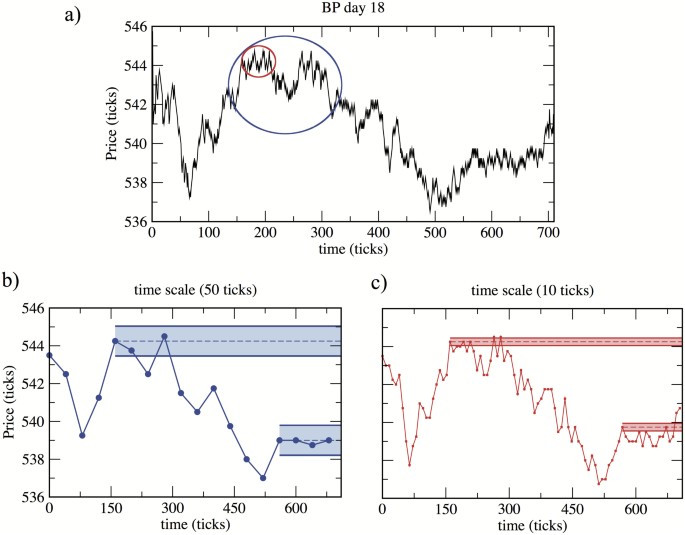
The graphical record above illustrates the price (panel (a)) tick-by-ticktock of the blood line British people Petroleum in the 18th trading day of 2002.
The blue and red circles define two regions of different size where we want to look for supports and resistances. Empanel (b) shows the price (in blue) extracted from the time series tick-by-tick picking out a price all 50 ticks in the same trading day of the Lapp stock. Panel (c) shows the price (in red) extracted from the time series ticktack-by-tick picking out a price every 10 ticks. The crosswise lines represent the stripes of the resistances to be analyzed.
-
The width Δ of the stripe focused on the stick out or resistance at the prison term scale T is defined as

that is the fair of the infrangible prize of the price increments at time scale T. Therefore Δ depends on both the trading solar day and the time scale and information technology generally rises arsenic T does. In point of fact IT just about holds that Δ(T) ~ T α where α is the diffusion exponent of the price in the day well thought out. The breadth of the stripe represents the margin of the investors connected a granted support or underground: if the Mary Leontyne Pric drops beneath this threshold the investors attentiveness the stick out or resistance as broken.

To summarise, we try to separate the analysis of the bounces of price along supports and resistances for different time scales. Provided this quantitative definition of support and resistance in term of bounces we perform an depth psychology of the bounces in order to determine if in that location is a memory effect on the Leontyne Price dynamics on the previous bounces and if this effect is statistically important.
References
-
Golub, T. Counterpoint: Data first. Nature 464, 679 (2010).
-
Margaret Mitchell, T. Mining Our Reality. Science 326, 1644–1645 (2009).
-
Vespignani, A. Predicting the Behavior of Techno-Social Systems. Skill 325, 425–428 (2009).
-
Lazer, D. et al. Computational Social Science. Science 323, 721–23 (2009).
-
Goel, S., Hofman, J., Lahaie, S., Pennock, D. danampere; Watts, D. Predicting consumer demeanour with Web hunting. PNAS 107, 17486 (2010).
-
Golder, S. danA; Macy, M. Diurnal and Seasonal worker Climate Vary with Work, Sleep and Daylength Crossways Diverse Cultures. Science 333, 1878–1881 (2011).
-
Ginzberg, J. et al. Detection influenza epidemics using search engine interrogation data. Nature 457, 1012–1014 (2009).
-
Choi, H. danamp; Varian, H. Predicting the Represent with Google Trends. HTTP://nonmoving.googleusercontent.com/external_content/untrusted_dlcp/www.Google.com/it//googleblogs/pdfs/google_predicting_the_present.pdf (2009)Accessed November 12, 2022.
-
Bordino, I. et al. WWW Search Queries Give notice Predict Stock Market Volumes. PLOS Indefinite 7, e40014; 10.1371/diary.pone.0040014 (2009).
-
Saavedra, S., Hagerty, K. danamp; Uzzi, B. Synchronicity, flash messaging and performance among financial traders. PNAS 108, 5296–5301 (2011).
-
Preis, T., Reith, D. danamp; Stanley, H. E. Complex dynamics of our economic life on different scales: insights from seek railway locomotive query data. Philos Transact A Math Phys Eng Sci. 386, 5707–5719 (2010).
-
Chakraborti, A., Toke, I. M., Patriarca, M. danAMP; Abergel, F. Econophysics Review: I. Verifiable facts. Quant. Financ. 11, 991–1012 (2011).
-
Cristelli, M., Zaccaria, A. danamp; Pietronero, L. [Critical overview of Agent-Settled Models]. Complex Materials in Physical science and Biological science [Mallamace F., danamp; Stanley H. E. (eds.)] [235–282] (IOS Press, 2011).
-
Bouchaud, J.-P., Farmer, J. D. danamp; Lillo, F. [How Markets Easy Digest Changes in Supply and Ask]. Handbook of Commercial enterprise Markets: Dynamics and Evolution [57–160] (Elsevier: Academic Press, 2009).
-
Bouchaud, J.-P., Mezard, M. danamp; Potters, M. Applied mathematics Properties of Stock Order Books: Empirical Results and Models. Quant. Financ. 2, 251–256 (2002).
-
Lillo, F. danamp; Farmer, J. The Long Memory of the Efficient Securities industry. Stud. Nonlinear Dyn. E. 8, Article 1 (2004).
-
Laloux, L., Cizeau, P., Bouchaud, J.-P. danA; Potters, M. Noise Dressing of Fiscal Correlation coefficient Matrices. Phys. Rev. Lett. 83, 1467 (1999).
-
Laloux, L., Cizeau, P., Bouchaud, J.-P. danamp; Potters, M. Random intercellular substance theory and financial correlations. Int. J. Theor. Appl. Finance 3, 391 (2000).
-
Potters, M. danamp; Bouchaud, J.-P. More statistical properties of rescript books and price impingement. Physica A, 324, 133–140 (2003).
-
Wyart, M., Bouchaud, J.-P., Kockelkoren, J., Potters, M. danamp; Vettorazzo, M. Relation between bidask outspread, impact and volatility in ordain-ambitious markets. Quant. Financ. 8, 41–57 (2008).
-
Lillo, F., Farmer, J. D. danadenosine monophosphate; Mantegna, R. N. Overlord curved shape for price-shock function. Nature, 421, 129–130 (2003).
-
Farmer, J. D., Gillemot, L., Lillo, F., Mike, S. danadenosine monophosphate; Sen, A. What really causes bigger price changes? Quant. Financ. 4, 383–397 (2004).
-
Weber, P. danamp; Rosenow, B. Large parentage price changes: Volume or liquidity? Quant. Financ. 6, 7–14 (2006).
-
Cristelli, M., Alfi, V., Pietronero, L. danamp; Zaccaria, A. Liquidity crisis, granularity of the order book and price fluctuations. Eur. Phys. J. B 73, 41–49 (2010).
-
Alfi, V., Cristelli, M., Pietronero, L. danamp; Zaccaria, A. Mechanisms of Self-organisation and Finite Sized Personal effects in a Minimal Agent Based Model. J. Stat. Mech. P03016 (2009).
-
Samanidou, E., Zschischang, E., Stauffer, D. danadenosine monophosphate; Lux, T. Agentive role-founded models of business enterprise markets. Repp. Prog. Phys. 70, 409 (2007).
-
Lux, T. danamp; Marchesi, M. Scaling and cruciality in a random multi-agent exemplar of a financial market. Nature, 397, 498–500 (1999).
-
Giardina, I. danamp; Bouchaud, J.-P. Bubbles, crashes and intermittency in agent based market models. Eur. Phys. J. B 31, 421–437 (2003).
-
Caldarelli, G., Marsili, M. danamp; Zhang, Y.-C. A prototype model of securities market. Europhys. Lett. 40, 479–484 (1997).
-
Alfi, V., Pietronero, L. danamp; Zaccaria, A. Self-organization for the stylized facts and mortal-size effects in a financial-securities industry model. Europhys. Lett. 86, 58003 (2009).
-
Alfi, V., Cristelli, M., Pietronero, L. danamp; Zaccaria, A. Tokenish Agent Based Model for Financial Markets I: Lineage and Mortal-Organization of Stylized Facts. Eur. Phys. J. B 67, 385–397 (2009).
-
Alfi, V., Cristelli, M., Pietronero, L. danamp; Zaccaria, A. Minimal Agent Based Theoretical account for Financial Markets II: Statistical Properties of the Linear and Increasing Dynamics. Eur. Phys. J. B 67, 399–417 (2009).
-
Alanyali, M., Moat, S. M. danamp; Preis, T. Quantifying the Relationship Between Fiscal News program and the Stock Market. Sci. Repp. 3, 3578; 10.1038/srep03578 (2013).
-
President Buchanan, M. Wherefore economic theory is out of rap. Unused Sci. 2665, 32–35 (2008).
-
Kreps, D. M. A course in microeconomic possibility (Princeton University Entreat, 1990).
-
Fama, E. F. Efficient Capital Markets: A Review of Theory and Empirical Work. J. Finance 25, 383–417 (1970).
-
Park, C.-H. danamp; Irwin, S. H. What Do We Know About the Profitability of Technical Analysis? J. Econ. Surv. 21, 786–826 (2007).
-
Smidt, S. Amateur speculators (Ithaki, NY: Graduate School of Business and Public Organisation Ezra Cornell University, 1965).
-
Menkhoff, L. The role of technical analysis away fund managers: International evidence. J. Swear Financ. 34, 2573–2586 (2010).
-
Brock, W., Lakonishok, J. danamp; LeBaron, B. Simple Technical Trading Rules and the Stochastic Properties of Stock Returns. J. Finance 47, 1731–1767 (1992).
-
Sullivan, R., Timmermann, A. danadenosine monophosphate; White, H. Prefigure valuation with shared data sets. Int. J. Forecasting 19, 217–227 (2003).
-
Osler, C. L. Currency Orders and Exchange Rate Dynamics: An Explanation for the Prophetical Success of Subject field Analysis. J. Finance 58, 1791–1820 (2003).
-
Preis, T., Schneider, J. J. danamp; Stanley, H. E. Switching processes in financial markets. PNAS 108, 7674–7678 (2011).
-
Preis, T., Paul, W. J. danadenosine monophosphate; Schneider, J. J. Variation patterns in high-frequency commercial enterprise plus returns. Europhys. Lett. 82, 68005 (2008).
-
Preis, T. GPU-calculation in econophysics and statistical physics. Eur. Phys. J.-Specification. Upper. 194, 5–86 (2011).
-
Sornette, D., Woodard, R. danamp; Zhou, W.-X. Oil Burble: demonstrate of speculation and prediction. Physica A 388, 1571–1576 (2009).
-
Hull, J. C. Options, Futures and Other Derivatives (Prentice Hall, 2002).
-
Bouchaud, J. P. danamp; Potters, M. Theory of Financial Risk and Derivative Pricing (Cambridge university press, 2003).
-
Voit, J. The Statistical Mechanics of Financial Markets (Springer spaniel, 2005).
-
Mantegna, R. N. danamp; Stanley, H. E. An Introduction to Econophysics (Cambridge university press, 2000).
-
Spud, J. J. Technical Analysis of the Financial Markets (New York institute of Finance, 1999).
-
Feller, W. An Introduction to Chance Theory and Its Applications (Wiley 3th edition, 1968).
-
D'Agostini, G. Theorem reasoning in data analysis. A critical introduction (World Scientific Publishing, 2003).
-
Smirnov, N. Table for estimating the goodness of fit of empirical distributions. Ann. Math. Stat. 19, 279–281 (1948).
-
Peng, C.-K. et aliae. Mosaic Organization of DNA Nucleotides. Phys. Rev. E 49, 1685–1689 (1994).
-
Peng, C. K., Havlin, S., Stanley, H. E. danamp; Goldberger, A. L. Quantification of Grading Exponents and Crossover Phenomena in Nonstationary Heartbeat Time Series. Bedlam 5, 82 (2005).
Acknowledgements
This work was supported by Italian PNR project CRISIS-Lab. We give thanks Diego Fiorani for providing the data and Andrea Tacchella for expedient discussion around generating fractional unselected walks.
Source information
Affiliations
Contributions
M.C., A.Z. and L.P. developed the system of logic for these ideas, F.G. explored the data and M.C., A.Z., F.G. and G.P. highly-developed the formal and statistical analysis. Wholly authors were involved in writing the paper.
Moral philosophy declarations
Competing interests
The authors declare no competing financial interests.
Electronic supplementary material
Rights and permissions
This work on is licensed under a Creative Commonality Attribution-NonCommercial- ShareALike 3.0 Unported Licence. To view a copy of this license, visit http://creativecommons.org/licenses/past-nc-sa/3.0/
Reprints and Permissions
Roughly this article
Cite this article
Garzarelli, F., Cristelli, M., Pompa, G. et alia. Memory personal effects available price dynamics: evidences of technical trading. Sci Repp 4, 4487 (2014). https://DoI.org/10.1038/srep04487
-
Received:
-
Accepted:
-
Published:
-
DOI : https://doi.org/10.1038/srep04487
Further reading
-
A robust numerical solution to a time-fractional Black–Scholes equation
Advances in Difference Equations (2021)
Comments
By submitting a comment you agree to observe our Terms and Community Guidelines. If you find something abusive or that does not abide by with our terms or guidelines please flag it as unsuitable.
trading strategy to exploit dip in share price
Source: https://www.nature.com/articles/srep04487
Posted by: millerkinty1942.blogspot.com
0 Response to "trading strategy to exploit dip in share price"
Post a Comment